PRACTICAL & THEORETICAL SKI TRAINING IN THREE STEPS
Modern Ski Technique
Do you love skiing and want to take your skills to the next level? Whether you’ve been skiing for years and want to progress in an inspiring group, or you haven’t yet discovered the full joy of skiing, our program opens a whole new world, showing you how much more you can get out of the sport than you ever thought possible!
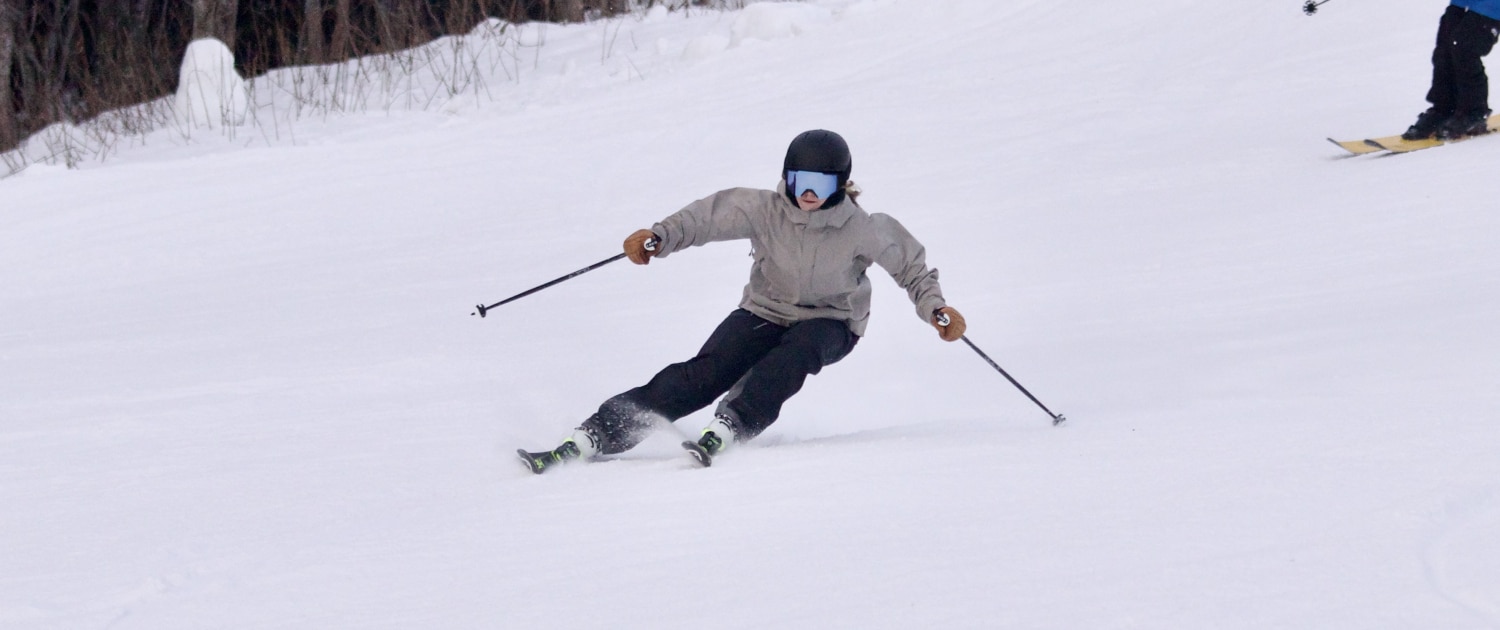
Modern Ski Technique is a unique training program in Åre designed for experienced skiers who want to deepen their understanding of both technique and equipment together with like-minded enthusiasts and dedicated coaches. We offer an exclusive all-round experience where on-snow training is combined with practical workshops in our specialized ski shop. You’ll learn to analyze your own skiing, gain deeper knowledge of equipment, and test the very latest in modern ski gear.
Our goal is not the “perfect turn” but to give you the tools for personal development, greater understanding, and maximum skiing enjoyment!
About the course
Step 1
We lay the foundation of modern ski technique with a focus on balance, movement patterns, and how the body affects the skis during a turn. You’ll learn the difference between skidded, steered, and carved turns and receive an introduction to edge-angle techniques. We also cover how equipment, from ski type to binding placement, affects your skiing. In our workshop, you’ll test different skis and learn the basics of ski maintenance. Suitable for skiers confident on red/black pistes who want to develop both technique and equipment knowledge.
Step 2
We deepen the technique with a focus on edge angle, body positioning, and efficient movement patterns. You’ll learn to handle G-forces and adapt your skiing to varied terrain, including easier off-piste. The course also includes pole technique, giant slalom training, and a theory session on boot fitting. Suitable for skiers confident on all pistes with some off-piste experience.
Step 3
The focus is on controlled free skiing in varied terrain and snow conditions. You’ll advance your technical knowledge for off-piste skiing and learn to use natural body movements in powder and uneven terrain. We also cover companion rescue, search techniques, avalanche terrain analysis, and smart decision-making in avalanche-prone areas. Suitable for experienced off-piste skiers looking to improve technique and stay safe in mountain environments.
Course overview
Step 1
Balance
In the first step, we focus on balance and ski technique. We look at how the movement of the center of mass and the base of support are connected to dynamic balance and how this affects our skiing. We will analyze how different movements in the ankle, knee, hip, and spine influence the ski’s interaction with the snow and how this, in turn, affects the ski.
Questions we will discuss:
How does my position on the ski change when I flex or extend the ankle or knee joint? How do the skis behave then? How does this affect our balance?
What forces act on me as a skier, and how do they influence my skiing?
How can we use our arms in a functional way related to pole planting?
We will test this in different snow conditions and terrain.
The different parts of a turn
We will go through different types of turns (skidded, steered, carved) and how different movements can create better control. When in the turn is it more or less functional to make movements that affect the skis? How does the type of turn influence your skiing?
Edging
Which movements, and in which joints, can we use to put the skis on edge?
In what ways can we edge the skis?
We will discuss this and test it on the slopes.
Equipment
We will look at:
The binding position on the ski in relation to the rotation point
The ski’s characteristics and how you can get more out of your skis
Different types of skis (piste, all-mountain, touring, etc.)
Does the choice of ski affect our technique?
We will bring different types of skis to the slopes so that everyone has the opportunity to try various kinds.
Ski maintenance
We will go through the following:
How to take care of your equipment
Edge sharpening/structure, side-edge tuning, waxing
What can you do yourself, and when should you take your skis to a workshop?
Who is this course for?
This course is for everyone who enjoys skiing.
Maybe you’ve been skiing for many years without thinking much about technique and now want to take the next step and develop together with others who share your interest. It’s both more fun and more inspiring to ski with others than to ski alone! Or perhaps you haven’t quite found the joy of skiing yet but want to experience the same excitement as the rest of your family. Either way, you will develop your skills, and this journey will be both rewarding and fun!
The course runs for three days, from Friday-Sunday. We have two different dates to choose from: January 16-18 and February 6-8, 2026.
We ski together from around 09:00 to 15:00, with a lunch break at one of Åre’s cozy slope-side restaurants.
One of the evenings will also include a theory session in our ski shop, where we will talk about equipment.
Prerequisites
You don’t need to be a very advanced skier to take part in Step 1, but you should be able to ski all red and black runs with parallel turns.
No theoretical knowledge is required.
Step 2
Edging
Questions we will discuss:
How does the sideways movement of the center of mass affect the skis?
In what different ways can we put the skis on edge?
How does the edging angle affect the ski’s grip on the snow, and how does it influence the size of the turn?
When you increase the edge angle, you are exposed to greater forces, G-force and the normal force increase in the turn. To handle this, you need to be in a position on the ski where you can resist the forces that arise (a basic position or a movement-prepared position).
We aim to find a position where you are ready for movement and strong enough to ski all day without your legs filling up with lactic acid.
We will also test skiing with a flat ski to create control and feel for the edge, and to adapt our skiing to different surfaces and snow conditions.
We will ski off-piste in untouched snow and on uneven terrain, working on getting the skis to float better on variable surfaces.
Here, we deepen our understanding of how edging affects the ski’s grip and turn radius. You will learn to optimize your position to resist the forces in the turns and to ski with a flat ski for better control. We will explore different terrain and snow conditions to adjust your technique, including off-piste skiing and how to adapt your skiing to changing conditions.
Surface
How do different surfaces affect the choice of skiing technique?
We go through the concept of moment of inertia and how you can use it to your advantage in skiing.
Choice of turn
Skidded turn – the ski is relatively flat
Steered turn – steering angle
Carved turn
Rotation
We don’t always ski with a pure carve, even if we might think so.
Sometimes we skid, sometimes we carve, and most often we do something in between. To regulate this, we rotate the skis, something most skiers do without thinking. Understanding how to rotate your skis can greatly help you progress as a skier.
How do I rotate my skis in a short turn, and how do I do it in a large carved turn?
Pole planting
We discuss the advantages and disadvantages of pole planting in relation to force and momentum. When does good pole planting help our skiing, and when can it make it worse?
Gate training
Together, we will set up a giant slalom course and practice giant slalom technique.
Analysis
We analyze our own and others’ movement patterns and how they affect skiing. We now understand that all our movements influence how the ski interacts with the snow, which allows us to begin analyzing ourselves and others.
We discuss:
Where in the turn do I find it hardest to maintain control or grip?
Why do my thighs get tired?
We can start finding the answers to these questions by feeling how we stand on the skis. We will also make a simple movement description of a turn. Where is our center of mass in the different parts of the turn? Initiation / steering phase / completion.
We look at the tracks in the snow and use them to analyze how we are positioned on the skis in different parts of the turn.
Equipment
The ski boot is one of the most important parts of the equipment.
We will talk about and look at different types of boots (last shapes, liners) and what modifications can be made to the skis (shell stretching/grinding, lifters, custom insoles, etc.). This session will take place in our ski shop and is led by one of our knowledgeable bootfitters.
On the slopes, we will have various types of skis (piste, all-mountain, etc.) to test.
Who is this course for?
This course is for anyone who enjoys skiing and likes to do it with others who share the same interest and want to develop as skiers.
The course lasts three days, with skiing from approximately 09:00–15:00 each day, and a theory session one evening in our ski shop (Åre Sportshop). 2026 year’s Step 2 course runs from Friday-Sunday, both January 23-25 and March 6-8.
Prerequisites
You have either completed Step 1 Modern Ski Technique, Step 1 SLAO Ski Instructor, or a similar course where you gained an understanding of how our movements affect the skis, with a focus on balance. (Not a requirement, but recommended, as this step focuses more on edging and rotation.)
You ski all runs with parallel turns, turn after turn, and you also ski off-piste in blue/red terrain.
Step 3
Freeriding and Avalanche Knowledge
In the final step, we tackle all types of terrain, focusing on off-piste skiing and avalanche knowledge. You will learn to adapt your technique for untouched snow and uneven terrain, while also deepening your understanding of safety and risk management outside the marked slopes.
We will begin the course by seeking the best possible skiing, preferably in untouched snow. We explore different surfaces and discuss how to vary your technique depending on the terrain.
Questions we will discuss:
When should we stay light on the snow and ski with relatively flat skis, and when do we want to edge the skis more for better grip?
When and how do we rotate the skis in untouched off-piste snow?
How should we position ourselves on the skis to make turning as easy as possible?
How can we use the movement patterns of our central joints (ankle, knee, hip, spine) to create simple and natural movement?
Differences and functions of skis (camber, width, length, radius…). We will test different ski models and see how they affect our technique.
We will then go through basic avalanche safety for freeriding and ski touring, where you will learn companion rescue techniques and how to identify avalanche terrain.
You will learn the fundamentals of avalanche-smart behavior in the mountains.
Course objectives
Companion rescue
Identify avalanche terrain
Minimize risks
Snow and avalanche knowledge
Search techniques
Risks associated with off-piste skiing
We aim to find good off-piste skiing while discussing the risks of skiing outside the lift system and what to consider to minimize those risks. Our instructors are experienced and follow the national training concept developed by SVELAV.
Equipment for the course
Appropriate clothing for varying mountain environments and weather
Digital avalanche transceiver with 3 antennas and marking function
Shovel with straight, flat blade
Probe
Freeride skis suitable for ski touring (randonée)
Climbing skins
Backpack
Insulating layers
First aid kit
If you lack any of the above, equipment is available for rent in our shop.
Step 3 will be held on two occasions in the 24/25 season: Friday, January 30 to Sunday, February 1, and Friday, March 13 to Sunday, March 15.
Prerequisites
You have either completed Step 2 Modern Ski Technique, Step 2 SLAO Ski Instructor, or a similar course. You must have home/accident insurance that covers off-piste skiing.
You should be able to ski off-piste in different snow conditions.
Price
4500 SEK per step
Sign up here
"*" indicates required fields